
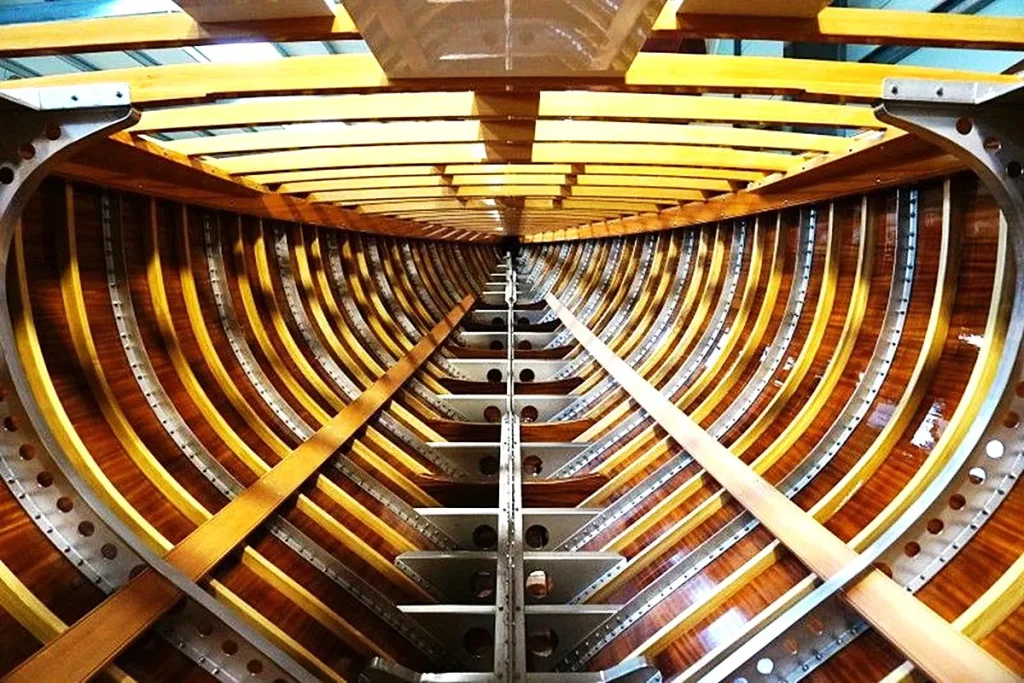
Classic yachts were built during a time when craftsmanship, patience and attention to detail were considered essential values in the creation of unique vessels. Their designers and builders understood that true quality could not be rushed, and that time was not an obstacle, but rather a fundamental component of the creative process.
These yachts were conceived and built with the finest materials
teak, mahogany, bronze and other carefully selected elements — by skilled craftsmen who dedicated countless hours to achieving the highest standards of construction. The result was not simply a yacht, but a work of art designed to endure, improve with age and preserve its identity for generations. One of the greatest differences between the past and today lies in the perception of time. In previous decades, owners were often prepared to wait. They understood that creating something unique required patience, and that excellence could only be achieved through a meticulous process of design, construction and refinement. The waiting period was part of the experience, because the final result justified the investment of time.
Today, however, the luxury industry is increasingly influenced by the pressure of immediacy. Customers are often accustomed to demanding shorter delivery times, and manufacturers, eager to satisfy expectations and remain competitive, sometimes accept unrealistic schedules. But when this approach is applied to complex, highly customised projects, there is a risk that time becomes an enemy rather than an ally.
A luxury product — and particularly a yacht — is not an industrial object that can simply be accelerated through production optimisation. Every project involves a combination of engineering, craftsmanship, creativity and human expertise. The smallest details, which often define the character and value of a yacht, require time: the perfect alignment of a wooden panel, the finishing of a surface, the integration of complex systems, or the careful selection of materials. The question is therefore not whether projects can be completed faster, but whether speed should always be considered a measure of efficiency. Perhaps part of the responsibility lies with the industry itself. In an effort to please clients, some companies may be tempted to promise delivery times that do not fully reflect the complexity of the work involved. However, luxury is built on trust, and trust begins with transparency. A client who truly understands the process is often more willing to accept a realistic timeline if it guarantees a superior result.
What would happen if manufacturers were more transparent from the very beginning? If they clearly explained that the creation of an exceptional yacht requires a certain amount of time, not because of inefficiency, but because quality demands dedication? The answer may be a different relationship between owner and builder — one based not only on expectations, but on shared values. The client would no longer perceive time as a delay, but as an investment in achieving something unique.
History has already demonstrated that the yachts which survive the passage of time are not necessarily those built the fastest, but those built with the greatest care. Their value comes from the combination of design, materials, craftsmanship and the passion of the people who created them. In the world of luxury yachting, time should not be seen as a constraint to overcome. It should be recognised as one of the most precious ingredients of excellence.
Time is not a delay. Time is part of the value creation process.