
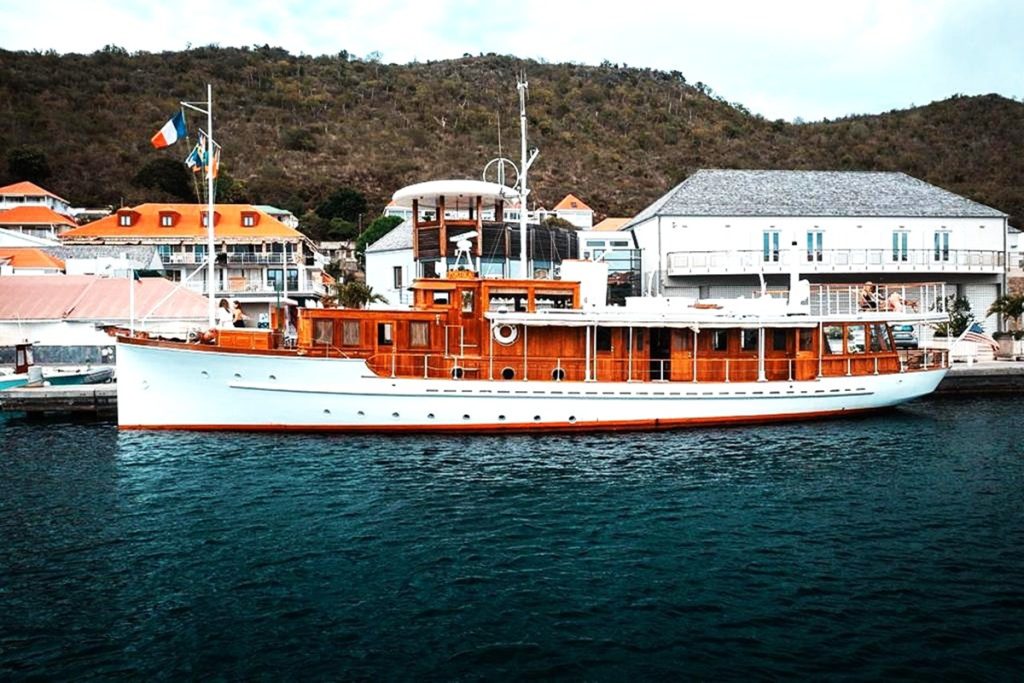
Successfully completing a yacht refit, restoration or conversion can provide an extraordinary sense of accomplishment. It requires not only technical skills and experience, but also the ability to understand the vessel, its history and the vision of its owner.
The idea of bringing an old yacht back to life has always attracted collectors and enthusiasts who recognise that a classic yacht can represent much more than a valuable asset. Restoring her can mean preserving a piece of maritime history, craftsmanship and design for future generations. Yet, the word “restoration” is often used rather broadly.
What does it actually mean to restore a yacht? There is no single answer.
Restoration can take many forms
A restoration project may involve the partial reconstruction of a yacht, the complete rebuilding of certain areas, or simply the recovery of specific elements that have deteriorated over time. In some cases, the objective may be to restore the original structure, joinery, machinery, systems or interior details as faithfully as possible. In others, certain parts may need to be modified or completely redesigned to meet the owner’s requirements, improve safety, enhance comfort or comply with current regulations. There are therefore very different levels of intervention.
A yacht may require a relatively conservative restoration, where the objective is to preserve as much of the original vessel as possible. At the other end of the spectrum, a project may involve substantial reconstruction, with large portions of the yacht being rebuilt while retaining the original identity, lines and character of the vessel.
Between these two extremes lies an almost unlimited range of possibilities.
Respecting the original design
For historically significant yachts, one approach is to remain as faithful as possible to the original drawings, materials, construction techniques and aesthetic language of the period. This approach can require considerable research. Original plans, photographs, builder’s records, technical documentation and historical references can become essential tools in determining how the yacht was originally conceived.
Where possible, original details can be repaired rather than replaced, and missing elements reproduced using traditional materials and craftsmanship. This philosophy is particularly important when dealing with yachts whose value lies not only in their age, but also in their provenance, design, craftsmanship or association with a particular period of maritime history. In these cases, authenticity becomes an integral part of the restoration.
When innovation becomes part of the project
However, restoring a yacht does not necessarily mean freezing her in time. Modern owners expect a level of comfort, safety, reliability and functionality that may simply not have existed when the yacht was built. Electrical systems, navigation equipment, fire protection, insulation, plumbing, air conditioning, propulsion systems and other technical installations may need to be upgraded or replaced. Current regulations can also require significant modifications.There are therefore situations in which innovation is not only acceptable, but necessary.
The real challenge is to introduce modern technology without allowing it to erase the character of the yacht. A modern navigation system, for example, can be integrated discreetly without compromising an original wheelhouse. Contemporary technical equipment can be installed while respecting the architectural language of the vessel. Modern materials may sometimes be used where they offer clear technical advantages, provided that their appearance and application remain coherent with the yacht.
The objective is not to reject modern technology. It is to make modern technology serve the yacht rather than dominate it.
The owner’s vision
Every restoration project is ultimately influenced by the owner’s expectations.
One owner may want an almost museum-quality restoration, with an emphasis on authenticity and historical accuracy. Another may want to use the yacht extensively and require a more practical approach, combining original features with modern systems, improved accommodation and contemporary standards of comfort. Neither approach is necessarily wrong. The difficulty lies in finding the right balance.
A yacht is both a technical object and a cultural object. It has to function safely and efficiently, but it may also possess a historical and emotional value that cannot be measured purely in financial terms. The owner’s vision must therefore be understood from the beginning of the project.
What is the purpose of the restoration?
Is the yacht intended for private cruising, classic yacht regattas, charter, occasional use or simply preservation?
How important is historical authenticity?
Which elements are considered essential by the owner?
How much modernisation is acceptable?
These questions should be answered before major decisions are made.
The danger of unnecessary alterations
Perhaps one of the greatest risks in restoring a classic yacht is making changes simply because they appear easier, cheaper or more convenient. Once an original feature has been removed, it may be impossible to reproduce it with the same authenticity later. A change to the interior layout, the removal of original joinery, the replacement of traditional materials with inappropriate modern alternatives or alterations to the exterior lines may seem insignificant in isolation. Collectively, however, such decisions can fundamentally alter the character of a yacht. This is particularly relevant when modifications are justified primarily by cost reduction.
Saving money during a restoration is not necessarily saving value.
In some cases, the opposite can be true. An inexpensive solution may reduce the historical authenticity of the vessel, compromise craftsmanship or negatively affect her future desirability among knowledgeable collectors. A restoration should therefore be evaluated not only according to its immediate cost, but also according to the long-term consequences of the decisions being made.
Finding the right compromise
The most successful restoration projects are rarely based on an absolute philosophy. They are based on balance. There may be occasions when an original component should be preserved at almost any cost because it represents an important part of the yacht’s identity.
There may also be situations where reproducing an obsolete system makes little technical or economic sense, and a carefully integrated modern solution is the better choice. The skill lies in knowing the difference. This requires more than technical knowledge. It requires an understanding of the yacht’s history, construction, materials, design and intended future use. It also requires the ability to distinguish between a modification that genuinely improves the vessel and one that simply reflects a temporary preference or a short-term saving.
Preserving the story
Ultimately, the restoration of a classic yacht is not simply about repairing an old vessel. It is about deciding what should be preserved, what can be changed and what should be recreated. Every yacht has a story. Her lines, construction, interiors, machinery and even the traces of previous owners can form part of that story. A successful restoration should allow that story to remain visible. Modernisation can be appropriate. Reconstruction can be necessary. Innovation can be valuable. But these elements should always be introduced with an understanding of what makes the yacht unique in the first place. The objective is not necessarily to return every yacht to the exact day she left the shipyard. The purpose is to ensure that, after the work is completed, she remains recognisably herself.
That is perhaps the real challenge of restoration: finding the right balance between preservation and innovation, authenticity and functionality, history and the future.
Because restoring a classic yacht is not simply about bringing an old asset back to life.