
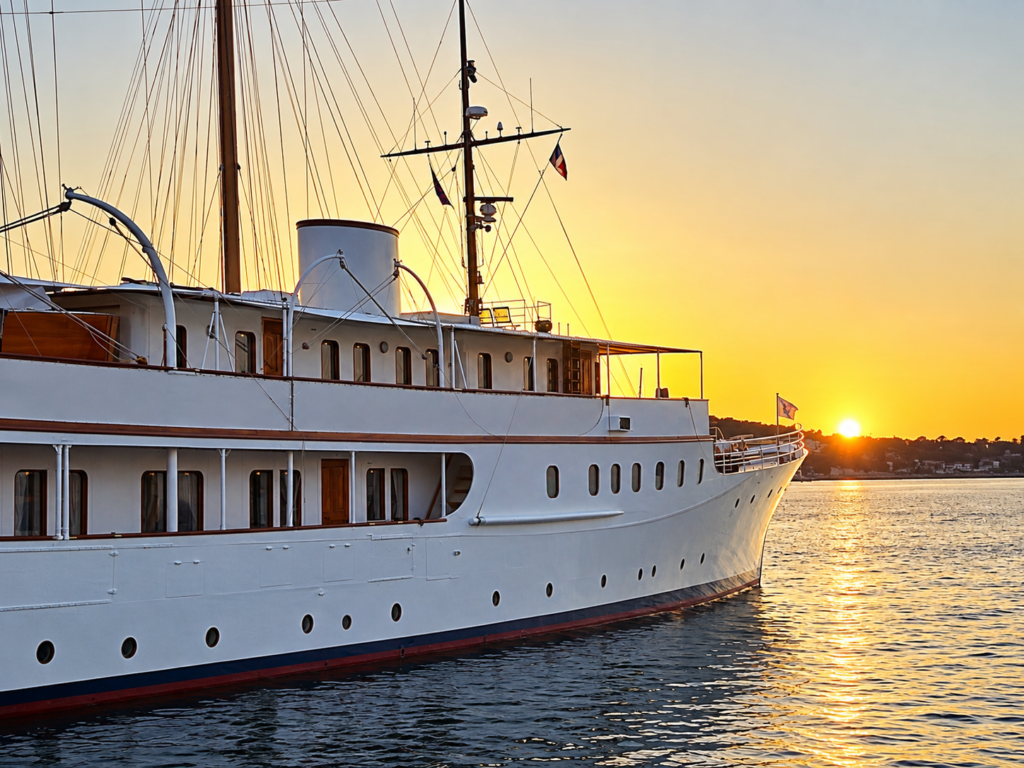
A classic yacht is the expression of a particular period, the work of a designer and a shipyard, the result of craftsmanship that may no longer exist, and often the witness to decades of maritime history. These characteristics can create a form of value that goes well beyond her use as a pleasure craft.
Classic yachts can represent an interesting opportunity for investors, collectors and private owners looking for an asset with rarity, character and long-term potential. But investing in a classic yacht requires a very different approach from purchasing a contemporary yacht. Age does not create value, but heritage does.
There is another dimension to owning a classic yacht that should not be overlooked: her potential as a powerful communication and marketing asset.
For a private individual, owning a historically significant yacht can become an expression of personal identity and culture. It can distinguish the owner from the standard image associated with contemporary luxury and create a form of recognition that is rooted in authenticity rather than simply in size, price or specification. A classic yacht can also represent a distinctive brand asset.
In a world where many luxury products and experiences increasingly follow similar codes, an authentic historic yacht can provide a company with a unique platform for communication, hospitality and relationship building. It can become a unique setting for private events, meetings, client experiences, brand storytelling and carefully selected corporate activities.
Rather than simply demonstrating financial capacity, a well-chosen classic yacht can express taste, cultural awareness, individuality and an appreciation for history.
In this sense, a classic yacht can be both an asset to preserve and a powerful tool to differentiate an individual or a brand from the standard.
Understanding what you are actually buying
Before considering the financial potential of a classic yacht, it is essential to understand the asset itself.
Who designed her? Which shipyard built her? When was she launched? Who commissioned her? Who owned her throughout her life? Where did she sail? Which significant events are connected to her? Which elements remain original?
These questions are not simply historical curiosities.They can have a direct impact on the yacht’s value. The provenance of a classic yacht can be particularly important. A distinguished ownership history, documented participation in important events, association with recognised personalities or an exceptionally well-preserved original configuration can contribute to creating an identity that cannot be reproduced.
Some yachts have become part of maritime history because of the people who owned them or the guests who stepped aboard. Their names can remain associated with personalities and events long after those moments have passed.
This is one of the unique characteristics of a classic yacht: her history travels with her.
Historical due diligence
For this reason, historical research should be an essential part of any serious acquisition.
Original plans, shipyard records, photographs, correspondence, logbooks, registration documents, previous surveys and restoration records can provide invaluable information. A yacht advertised as substantially original may, after detailed research, prove to have undergone significant modifications. Conversely, a yacht that appears to require substantial work may possess exceptional original features and documentation that make her particularly interesting from a collector’s perspective.
Understanding these differences before an acquisition is fundamental. Historical due diligence should therefore be carried out alongside technical and financial due diligence, not after the purchase.
The difference between restoration and renewal
A classic yacht’s condition is equally important. The objective is not necessarily to restore everything to a “like-new” condition. In many cases, this could actually diminish the characteristics that make the yacht valuable.
Original materials, construction details, finishes and even certain aspects of natural ageing can form part of the yacht’s identity. Aged wood, patina and traces of previous craftsmanship can tell a story that a newly manufactured replacement can never reproduce.
The challenge is therefore to determine what should be preserved, what needs to be repaired, what should be replaced and where modern technology can be introduced discreetly.
A successful restoration is not measured by how much has been replaced. It is measured by how much of the yacht’s identity has been preserved while making her safe, reliable and usable for the future.
Controlling the cost of ownership
The financial equation of a classic yacht does not end with the purchase price.
Maintenance, restoration, insurance, berthing, crew, technical management and regulatory requirements can represent a substantial part of the overall investment. This makes the preparation of a realistic long-term maintenance strategy essential.
A professional condition assessment can help distinguish between:
- immediate structural and safety requirements;
- essential technical work;
- preventive maintenance;
- restoration work;
- discretionary improvements;
- and investments that may contribute to preserving or enhancing the yacht’s future value.
The objective is not simply to spend less. It is to spend intelligently.
A cheaper intervention carried out without consideration for the yacht’s construction or historical character can ultimately become more expensive. Conversely, a carefully planned intervention using the right materials and craftsmanship can protect both the yacht and the owner’s investment.
The importance of the right craftsmen
Classic yachts often require knowledge that cannot be found in standard modern yacht maintenance.
Traditional wooden construction, historic joinery, traditional caulking, varnishing, rigging and mechanical systems can require highly specialised skills. Choosing the right craftsmen is therefore an important part of protecting the asset.
The question is not simply whether a contractor can complete the work. It is whether the contractor understands why the yacht was built in a particular way and how the original construction should be respected.
The best restoration projects often bring together traditional craftsmanship and carefully selected modern technology. Modern systems can improve safety, reliability and efficiency while remaining discreet and compatible with the character of the yacht.
The objective is not to make an old yacht look new. It is to allow an historic yacht to continue her life without losing what makes her unique.
From ownership cost to potential revenue
Depending on the yacht and the owner’s objectives, chartering can provide an additional source of revenue. However, charter income should never be considered in isolation.
Commercial use can increase operating costs, crew requirements, maintenance and wear. It can also influence the positioning of the yacht within the collector and classic-yacht market.
A proper analysis should therefore compare the potential charter revenue with the additional costs and consider the possible impact on the yacht’s long-term condition and value. For some yachts, selective charter activity may be an appropriate way of contributing to annual operating costs.
For others, private use and preservation may be more consistent with their historical and investment characteristics. There is no universal formula.
The strategy must be built around the individual yacht.
A well-planned restoration can potentially reposition a yacht within the market by improving not only her physical condition but also her documentation, presentation and overall credibility. At that point, an owner may decide to retain the yacht or consider a sale.
The right time to sell is part of the investment strategy established from the beginning.
The value of independent expertise
This complexity explains why a classic-yacht acquisition should not be approached solely as a brokerage transaction.
An informed acquisition may require the combined expertise of historians, naval architects, surveyors, restoration specialists, shipyards, craftsmen, technical managers, insurers and brokers.
The role of an independent yacht consultant is to bring these different areas together and provide the owner with an objective view of the asset.
This can include:
- Historical assessment
Understanding provenance, ownership, original configuration and documentation. - Technical assessment
Evaluating the structural and mechanical condition of the yacht and identifying future requirements. - Restoration strategy
Defining what should be preserved, repaired, rebuilt, adapted or discreetly modernised. - Cost optimisation
Establishing priorities and developing realistic maintenance and restoration budgets. - Craftsmanship and shipyard selection
Identifying qualified professionals capable of working with appropriate traditional techniques and materials. - Ownership strategy
Assessing private use, selective charter opportunities and long-term operating requirements. - Exit strategy
Monitoring the market and identifying the appropriate circumstances in which a sale may make sense.
This multidisciplinary approach can help transform a complex acquisition into a structured long-term project.
Investing in something that cannot be reproduced
The strongest argument for classic yachts as potential investments is perhaps their inherent scarcity. A contemporary yacht can be replaced by another new yacht with similar dimensions, performance and equipment. A historic yacht cannot.
A yacht built by a renowned shipyard in a particular period, according to a specific designer’s plans and using craftsmanship that may no longer exist is, by definition, difficult to reproduce.
Once a genuinely historic yacht has been lost through neglect, inappropriate restoration or excessive modification, her original character may be impossible to recover. This makes preservation an essential part of the investment equation.
Preserving the past while creating the future
Investing in a classic yacht is ultimately a long-term commitment. It requires an understanding of history, technical knowledge, financial discipline and respect for craftsmanship.
The objective should not simply be to acquire an old yacht and wait for her value to increase. It should be to protect what makes her valuable.
A well-chosen classic yacht, supported by rigorous historical research, professional technical assessment, carefully controlled maintenance and appropriate restoration, can remain both a pleasure asset and a significant piece of maritime heritage. And when the time eventually comes to pass her on, the greatest contribution an owner can make to her value may be the condition in which she is handed to the next custodian.
Because with a true classic yacht, ownership is not only about possession. It is about becoming the custodian of part of history.